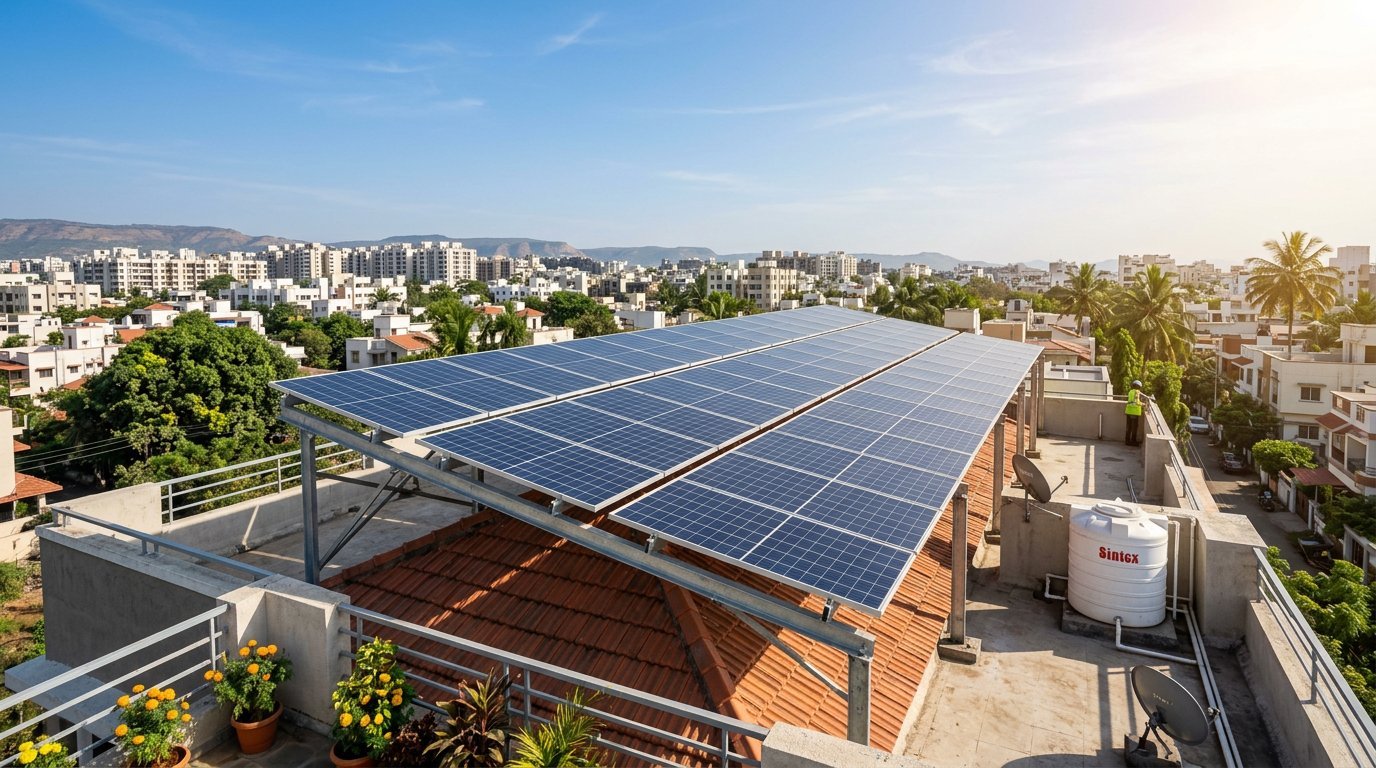
The PM Surya Ghar: Muft Bijli Yojana remains the single biggest reason residential rooftop solar pays back in three to four years instead of seven. Yet a large share of applications still get delayed for avoidable paperwork reasons. This guide explains the 2026 position in plain language.
How much subsidy do you actually get?
| System size | Central subsidy | Approx. system cost | Your net investment |
|---|---|---|---|
| 1 kW | ₹30,000 | ₹70,000 | ₹40,000 |
| 2 kW | ₹60,000 | ₹1,35,000 | ₹75,000 |
| 3 kW and above | ₹78,000 (capped) | ₹1,95,000 | ₹1,17,000 |
Two things surprise most homeowners. First, the subsidy is capped at ₹78,000 regardless of how large the system is — a 10 kW system still receives ₹78,000. Second, the subsidy is credited to your bank account after commissioning, not deducted from the invoice, although many vendors structure payments around it.
Who is eligible?
- Residential electricity consumers with an active connection in their own name.
- The installation must be done by a vendor registered on the national portal for your state.
- You must have a shadow-free roof area of roughly 10 m² per kW.
- The connection should be in the same name as the bank account and Aadhaar to avoid rejection.
The application sequence that works
- Register on the national portal with your consumer number and mobile number, and select your DISCOM.
- Submit rooftop details — area, type of roof and the capacity you want.
- Wait for feasibility approval from MSEDCL. This is where most delays occur; using a registered vendor speeds it up considerably because the follow-up happens locally.
- Install through the registered vendor only after approval. Installing first is the most common reason for rejected claims.
- Submit the commissioning certificate and net-meter details, along with bank account proof and cancelled cheque.
- Track the disbursement — in Maharashtra, credited accounts typically see the amount within 30 to 45 days of a complete claim.
Documents to keep ready
Latest electricity bill, Aadhaar, PAN, bank passbook or cancelled cheque, property tax receipt or ownership proof, and photographs of the completed installation with the net meter clearly visible.
Where applications go wrong
Name mismatches between the connection and the bank account, claiming capacity larger than the sanctioned load permits, and installing before feasibility approval. All three are avoidable if your vendor follows the sequence properly — which is exactly what we do for every customer at EcoHarbor.
Solar engineer at EcoHarbor Solar Share on WhatsApp
Need a quotation?
Our engineers will size a system for your exact roof and send a written proposal with subsidy and payback.
Book free surveyEstimate your savings
Use our calculator to see recommended kW, subsidy, net cost and 25-year savings in 10 seconds.
Open calculator